C4ISR
AI Orchestration in Battle Management Systems: The Next Evolution of Command and Control
How connected AI services, sensor fusion and interoperable software architectures could transform military decision support.
· 10 min read · DTN Editorial
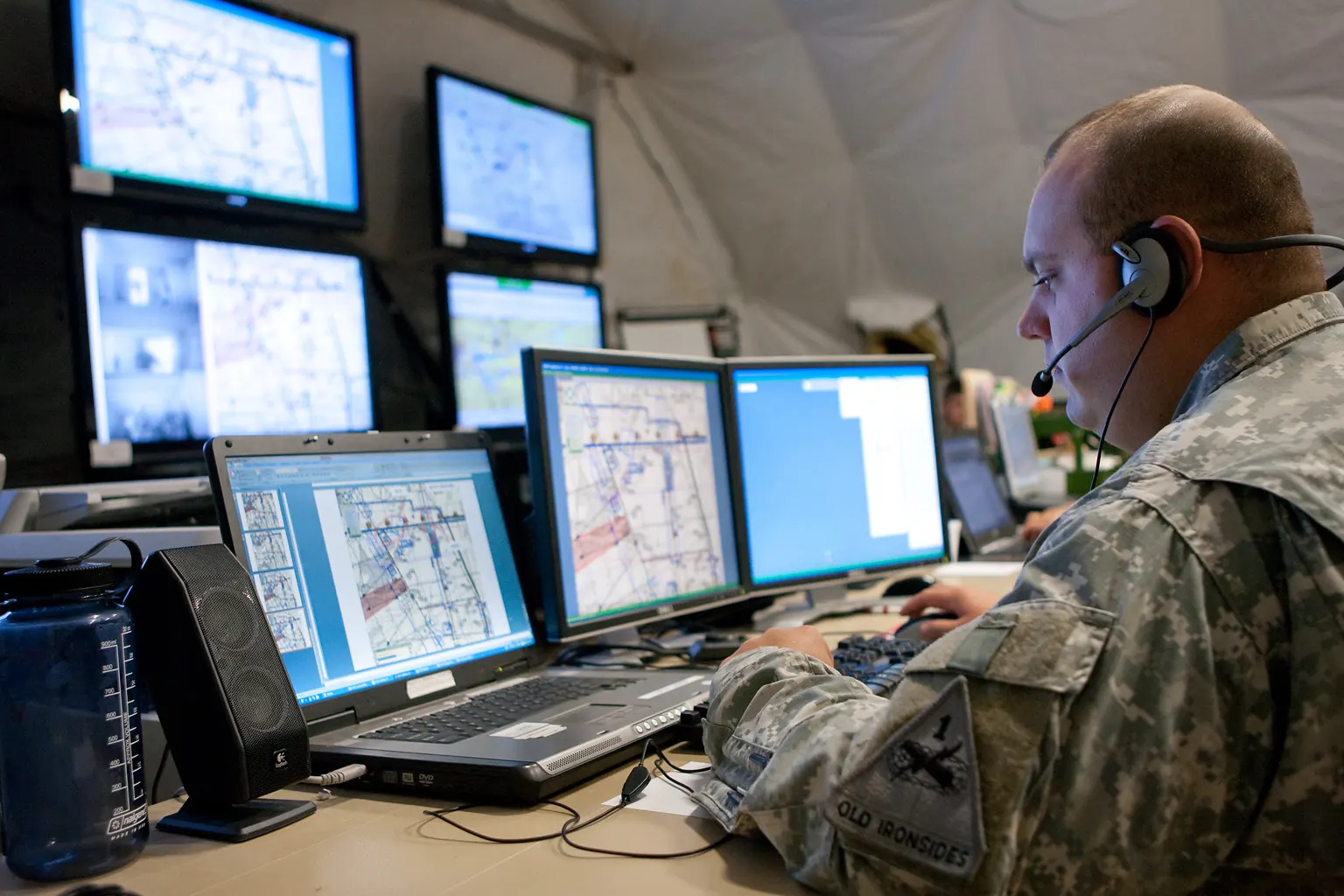
Modern forces collect more data than ever: from sensors, ISR platforms, logistics systems, communications networks and partner nations. More data does not automatically mean better decisions. Unless information is validated, put into context and delivered to the right person at the right time, it can increase staff workload and slow decisions rather than speed them up.
That is why attention is moving from individual tools to the way software services work together. This article explains what a battle management system is, why connected systems are not necessarily integrated, and how AI orchestration — the coordination of several specialised AI services under clear governance — could shape the next generation of command and control software. It is a conceptual overview, not a description of any specific national or classified system.
What is a battle management system?
A battle management system (BMS) is software that helps commanders and staff understand the situation, plan, coordinate forces and share information. Terminology varies between nations and services, so a few distinctions are useful:
- Command and control (C2) is the exercise of authority and direction over assigned forces. C2 software supports that function with planning, tasking, messaging and reporting tools.
- ISR — intelligence, surveillance and reconnaissance — covers the collection and analysis of information about an operating environment. ISR software manages collection, processing and dissemination of that information.
- A common operational picture (COP) is a shared display of relevant information, such as unit positions, observations and status, viewed by multiple users at different levels. See our guide to the common operating picture.
- C4ISR is the umbrella term combining command, control, communications, computers and ISR. A BMS is usually one component within a wider C4ISR environment, described in our overview of C4ISR systems.
In practice, a BMS ties these elements together on hardware ranging from headquarters workstations to vehicle terminals and handheld devices. Its value depends less on any individual screen than on the quality and timeliness of the information flowing through it.
Connected systems are not necessarily integrated
Many forces already have networks that link sensors, vehicles and headquarters. Being connected, however, is not the same as being integrated. Two systems can exchange messages yet interpret the same data differently: different coordinate formats, time references, classification labels or object identities. Operators then reconcile information manually, often under pressure.
Genuine integration requires shared data models, agreed interfaces, consistent metadata, access control and a clear view of data provenance — where information came from, how old it is and how reliable it is believed to be. Without that foundation, adding AI simply automates confusion: models trained or run on inconsistent data produce outputs that look precise but are hard to trust.
What is AI orchestration in defence?
AI orchestration is the coordination of multiple specialised software services — some AI-based, some conventional — within a defined workflow. An orchestration layer decides which services run, on which data, in which order, under which policies, and how their outputs are checked and presented.
It is not one all-knowing autonomous model. A credible orchestrated architecture uses many narrow components, each with a defined purpose and known limitations: a model that flags data anomalies, a forecasting service for maintenance, a translation tool, a classifier for imagery. The orchestration layer manages dependencies, applies confidence thresholds, records what happened and routes results to human reviewers. This modular approach also reflects how defence organisations buy and accredit software: components can be tested, replaced and approved separately.
NATO’s revised AI strategy and its Alliance Digital Strategy both emphasise data, interoperability and responsible adoption rather than any single platform — a useful signal of where allied requirements are heading.
What is AI agent orchestration?
AI agent orchestration is a specific form of AI orchestration in which some services are software agents: components, often built on language models, that can plan a sequence of steps and call tools or other services to complete a defined task, such as gathering records and drafting a summary. The orchestration layer constrains what each agent may access and do, sequences their work, checks outputs and logs every step.
It should be kept distinct from two neighbouring ideas. It is not sensor fusion, which combines sensor observations into a better estimate; an agent might request a fused track, but it does not perform the fusion. Nor is it autonomous decision-making: in the decision-support use described in this article, agents prepare information and recommendations within set permissions, and accountable people make and approve decisions. Where data is sensitive, such agents can run on private or air-gapped AI infrastructure.
Example: a non-combat readiness workflow
Consider a deliberately non-combat example: preparing a weekly readiness picture for a unit. Today this often involves staff collecting spreadsheets, maintenance records and communications reports from different systems. An orchestrated workflow might look like this:
- Data integration: maintenance, inventory, personnel availability and network status data are pulled from source systems through approved interfaces.
- Data quality: automated checks flag missing fields, stale records and contradictions between sources before any analysis begins.
- Equipment readiness: a predictive maintenance service estimates which vehicles or systems are likely to need work, with a stated confidence level.
- Communications status: a separate service summarises network availability and known outages.
- Decision support: results are cross-checked and combined into a concise summary with sources and uncertainties visible.
- Human review: a responsible officer approves, queries or returns the analysis. Nothing is actioned without that review.
The benefit is not that software makes the decision, but that staff spend less time collating data and more time judging it.
Sensor fusion vs AI orchestration
The two terms are often confused. Sensor fusion — or multi sensor data fusion — combines observations from several sensors to produce a more complete or more confident estimate, for example correlating radar and electro-optical detections into a single track. Sensor fusion software operates close to the data and is usually tightly engineered for particular sensor types.
AI orchestration operates at a higher level. It coordinates services, including fusion, across a workflow and applies governance to the results. A system can have excellent fusion and no orchestration, or orchestration that relies on several fusion services. For buyers, the distinction matters because the procurement, testing and accreditation questions differ. Our guide to drone detection systems shows how multi-sensor integration works in a narrower counter-UAS context.
Case study: Ukraine’s DELTA ecosystem
Ukraine’s DELTA system is frequently cited as a practical example of software-defined situational awareness. According to CSIS analysis, DELTA began in 2016 as a volunteer-developed digital map and grew bottom-up into an ecosystem of software applications used across Ukrainian defence forces, with tiered access for different command levels. CSIS compares its evolution to the concept of combined joint all-domain command and control, while noting its different, incremental development path.
In its official announcement, Ukraine’s Ministry of Defence describes DELTA as a combat digital ecosystem for real-time situational awareness, planning support and information sharing, deployed across all levels of the Defence Forces and accessible on laptops, tablets and smartphones. The ministry states the system passed information security validation, has been enhanced with an AI platform for automatic detection of equipment, and that new modules are under development.
The lesson for this discussion is architectural: a modular, interoperable ecosystem with AI-enabled elements, expanded step by step. Public sources do not describe DELTA as a fully autonomous orchestration system, and it should not be presented as one.
A five-layer reference architecture
A simple way to reason about AI-enabled command and control software is to separate it into five layers. This is a conceptual model for discussion, not a formal standard:
- Data sources: sensors, ISR platforms, logistics, C2 systems and partner feeds.
- Integration and governance: data standards, validation, access control, labelling and lineage.
- Specialised analytics: fusion, classification, forecasting and other AI or rules-based services.
- Orchestration: workflow coordination, policy enforcement and routing of results.
- Human decision support: operational picture, options, approvals and audit trail.
Separating layers lets organisations upgrade analytics without rebuilding data integration, and lets suppliers specialise. It also makes clear where accountability sits: at the top, with people.
Interoperability and NATO Federated Mission Networking
Coalition operations multiply the integration challenge. NATO’s Federated Mission Networking (FMN) framework provides agreed standards, procedures and instructions so that national and NATO systems can join mission networks and share information from day one, rather than building bespoke connections for each operation. FMN is delivered in successive “spirals” of specifications.
For AI orchestration, the implication is that services must work across sovereign boundaries: data labelled and protected according to agreed rules, interfaces published, and outputs understandable by partners. An AI service that only works inside one vendor’s environment is of limited coalition value.
Reliability, cybersecurity, limited connectivity and human oversight
Defence environments are harsh for software. Credible architectures need to address:
- Reliability: predictable behaviour, graceful degradation and tested failure modes.
- Cybersecurity: secure supply chains, accreditation, protection against data poisoning and manipulation of models.
- Limited connectivity: operation at the edge with intermittent, low-bandwidth or contested links, and safe synchronisation when connectivity returns.
- Explainability: outputs that show sources, confidence and reasoning in terms users understand.
- Auditability: logs of data, model versions and decisions for later review.
- Human oversight: clear points at which accountable people approve, override or reject outputs.
NATO’s Principles of Responsible Use — lawfulness, responsibility and accountability, explainability and traceability, reliability, governability and bias mitigation — offer a practical checklist for suppliers designing these properties in from the start.
The future of defence AI
The likely trajectory is evolutionary rather than revolutionary. Expect more modular, software-defined capabilities; greater attention to data standards and data-sharing agreements; and procurement that evaluates how components fit into an architecture. The organisations that benefit most may be those that invest early in data quality and integration — the unglamorous foundations on which useful AI depends.
Opportunities for defence technology providers
This shift creates openings for companies of different sizes, not only large prime contractors:
- Data integration, transformation and quality tooling for heterogeneous defence data.
- Specialised analytics: sensor fusion software, predictive maintenance, ISR software processing and translation.
- Edge computing and rugged hardware able to run services in disconnected environments.
- Security, identity and access management for multi-domain, multinational data.
- Test, evaluation and assurance services for AI components.
Success depends on documented interfaces, standards alignment and evidence of performance in realistic conditions. See also how resilience requirements are shaping buyers in our article on protecting critical infrastructure, and browse the C4ISR and sensors and ISR technology categories.
The Defence Technology Network perspective
DTN is an independent platform. We do not build or operate battle management systems. Our role is to help defence technology companies present their capabilities clearly and to help buyers and integrators find relevant suppliers across the layers described above — from data integration specialists to edge hardware and assurance providers. If your company contributes to command and control, ISR or decision-support architectures, a clear, well-structured profile makes it easier for the right people to understand where you fit.
Join the network free to receive curated opportunities and research, or explore more Technology Insights.
Frequently asked questions
What is a battle management system?
A battle management system is command and control software that helps military staff build situational awareness, plan, coordinate forces and share information across units. It typically combines a common operational picture, messaging, planning tools and links to sensor and ISR feeds.
Is AI orchestration the same as an autonomous system?
No. AI orchestration coordinates several specialised software services within a defined workflow, with validation steps and governance. In the decision-support context described here, outputs are recommendations or summaries reviewed by accountable people; it does not mean handing decisions to a single autonomous model.
How does sensor fusion differ from AI orchestration?
Sensor fusion (or multi sensor data fusion) combines observations from several sensors into a more complete or more confident estimate, such as a single track. AI orchestration sits at a higher level, coordinating which analytical services run, in which order, on which data and under which rules. Fusion can be one of the services an orchestration layer coordinates.
Why does interoperability matter for AI in command and control?
Coalition operations depend on sharing data across national systems. Without common standards for data, services and security, each AI capability becomes another silo. Frameworks such as NATO Federated Mission Networking aim to let partners join mission networks with agreed procedures and standards.
What should defence technology companies prepare to sell into this market?
Clear, documented interfaces; evidence of standards compliance; security accreditation readiness; behaviour under degraded or disconnected conditions; and explainable outputs with audit logs. Buyers increasingly evaluate how a component fits into a wider architecture, not only how it performs in isolation.
Sources
- NATO — Alliance Digital Strategy (2026)
- NATO — Summary of the revised Artificial Intelligence Strategy (2024)
- NATO — Summary of the AI Strategy and Principles of Responsible Use (2021)
- NATO Allied Command Transformation — Federated Mission Networking
- Ministry of Defence of Ukraine — DELTA deployed across all levels of the Defence Forces
- CSIS — Does Ukraine Already Have Functional CJADC2 Technology? (2024)
C4ISR and decision support
Show where your technology fits
Join DTN free for curated opportunities and research, and present your capability to the defence technology community.
Related insights
AI & Data
Air-Gapped AI: How Private AI Systems Work Without Cloud Connectivity
How private AI deployment works in isolated networks: architecture, model updates, security controls and the real trade-offs of offline AI systems.
C4ISR
Common Operating Picture (COP): How AI Supports Situational Awareness
What a common operational picture is, why data quality, provenance and latency decide its value, and where AI helps under human review.
C4ISR
C4ISR Systems: Architecture, Data Integration and the Role of AI
An educational guide to C2 and C4ISR terminology, system architecture, integration constraints and where AI realistically fits.
Counter-UAS
Drone Detection Systems: RF vs Radar and Other Counter-UAS Technologies
A procurement-focused comparison of RF, radar, electro-optical/infrared and acoustic drone detection, with selection criteria and supplier questions.