AI & Data
The Military Strategist of the Future Is Artificial Intelligence
Why AI may transform how defence leaders understand complexity, evaluate scenarios and make decisions—without replacing human command.
· 9 min read · DTN Editorial
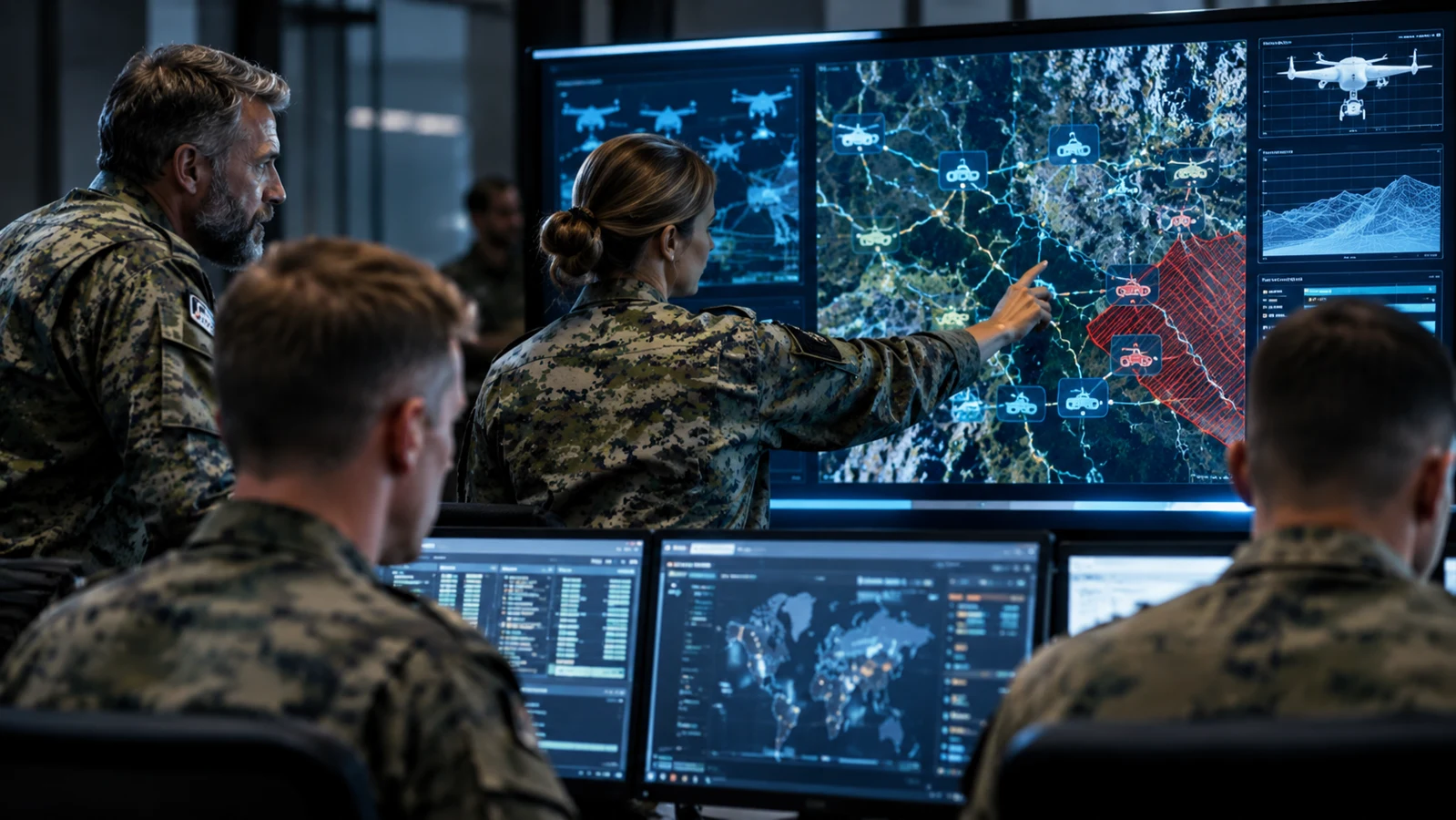
AI military strategy begins with a provocative question: who can make sense of a defence system whose moving parts exceed any individual's capacity to hold them together? Dozens of drone types, aircraft, ground vehicles, equipment, personnel, infrastructure, logistics and information interact through shifting dependencies. Uncertainty compounds the problem. Manual synthesis cannot continuously reconcile every change, conflicting report and long-term implication.
The headline is a proposition about analytical change, not a prediction of autonomous warfare. AI may become an essential co-strategist: a means of organising evidence, challenging assumptions and exploring uncertainty. It cannot become the accountable strategist. Humans own objectives, values, legitimacy, command decisions, law and ethics—and must remain able to question the analysis.
Strategy concerns purposes and choices, not tactical execution
Strategy connects political objectives with resources, risk and long-term choices. It asks what an institution seeks to achieve, what constraints are legitimate and what consequences it is prepared to accept. Operations and tactics concern different levels of activity. Analytical tools can blur those boundaries unless their permitted scope is explicit.
This discussion stays at the strategic and institutional level. It offers no operational targeting, deployment guidance, combat optimisation, attack planning, tactical recommendations, autonomous engagement or actionable adversary exploitation. The question is how defence leaders might better understand complexity—not how machines should conduct conflict.
An analytical co-strategist, never an accountable one
Good strategic analysis makes assumptions visible and asks whether an apparent answer survives scrutiny. AI could help compare documents, identify inconsistent estimates and organise dependencies that would otherwise remain scattered across teams. Its value would be broader analytical coverage, not an automatic right to decide.
Choosing which risks are acceptable involves political judgement and ethical commitments. Neither can be reduced to a model score. An AI recommendation may be internally consistent while pursuing the wrong objective. Human leaders must define the question, challenge the framing and retain responsibility for decisions, including decisions to disregard the software.
AI-agent orchestration brings analyses into a controlled workflow
AI-agent orchestration coordinates specialist services rather than asking one model to know everything. Conceptually, separate services might check data quality, summarise approved documents, compare institutional assumptions or flag inconsistent resource estimates. An orchestrator controls their sequence, inputs and permissions, with validation before outputs reach decision-makers.
The integration should preserve disagreements. If two analyses depend on different assumptions, their outputs should not be silently averaged into false consensus. Specialist agents may also share the same underlying bias or faulty source; their apparent agreement is not independent corroboration. More services create more integration responsibilities.
DTN's AI orchestration in battle management systems article discusses connected analytical services and interoperability. Here, the focus is institutional understanding and governance, not operational application.
A common operational picture is not common certainty
A common operational picture can organise authorised information into a consistent view. For strategic analysis, useful inputs might include aggregate equipment condition, infrastructure dependencies and documented institutional constraints. Consistent identifiers, timestamps and access rules are essential: a polished interface cannot repair contradictory records.
Each assessment should distinguish observation from inference, current information from stale information, and absence of evidence from evidence of absence. People need to inspect sources and see what remains unresolved. Our common operating picture guide explains why integration helps only when provenance and limitations remain visible.
A Civilian Analogy: From B2B Growth Intelligence to Decision Support
A civilian B2B international growth decision-support system developed within DTN's wider network offers a useful methodological analogy. In a first-person account supplied to DTN, its developer describes collecting tens of thousands of data rows from static databases and real-time sources. The model analyses this heterogeneous information and provides justified recommendations about what to do next and why, with feedback and self-learning. This is a supplied account, not an independently verified performance study; no client identities or measured business outcomes are claimed.
The useful pattern is heterogeneous data, followed by synthesis and domain-specific decision logic, then reasoned recommendations with explicit uncertainties, a human decision, a monitored outcome and validated learning. The developer reports feedback and learning; the quality of uncertainty handling and learning validation would still need evidence. A human always makes the final consequential decision. Feedback can inform subsequent analysis, but cannot confer decision authority on the model.
Domain logic is the core. In the civilian system, commercial expertise and growth objectives shape how information is interpreted and recommendations are justified. A hypothetical military decision-support system would require its own decision logic, constraints, objectives and oversight, designed and validated by qualified military professionals. Commercial priorities cannot simply become defence priorities, and a plausible recommendation is not evidence of sound military judgement.
“The methodology is transferable. The expertise, decision rules, risk tolerance and accountability are not.”
Copying software or swapping datasets would not be sufficient. Cybersecurity, adversarial uncertainty, legal obligations, governance, reliability, human judgement and validation all require major adaptation and independent scrutiny. This analogy complements the separate civilian logistics case: it illustrates an information-to-decision pattern, not a deployed military strategist, a military-ready technology or proof that civilian expertise can replace military responsibility.
Competing hypotheses are more useful than confident predictions
Strategic questions rarely have one dependable forecast. Conceptual scenario modelling can help examine how an assessment changes under different assumptions about institutional demand, infrastructure availability or technology maturity. Its purpose is to expose sensitivity, not predict human behaviour with certainty.
Competing hypotheses should include explanations that challenge the preferred narrative. What evidence would weaken each interpretation? Which assumptions dominate the conclusion? Where does the model have no defensible basis for an estimate? AI can help structure those questions, but the plausibility of a scenario remains a matter for expert review.
A scenario is not a recommendation to act. Presenting several possibilities with transparent boundaries may be more valuable than selecting a single “best” outcome. A useful system should be able to say that available information does not support a reliable comparison.
Resource trade-offs belong to institutions and accountable people
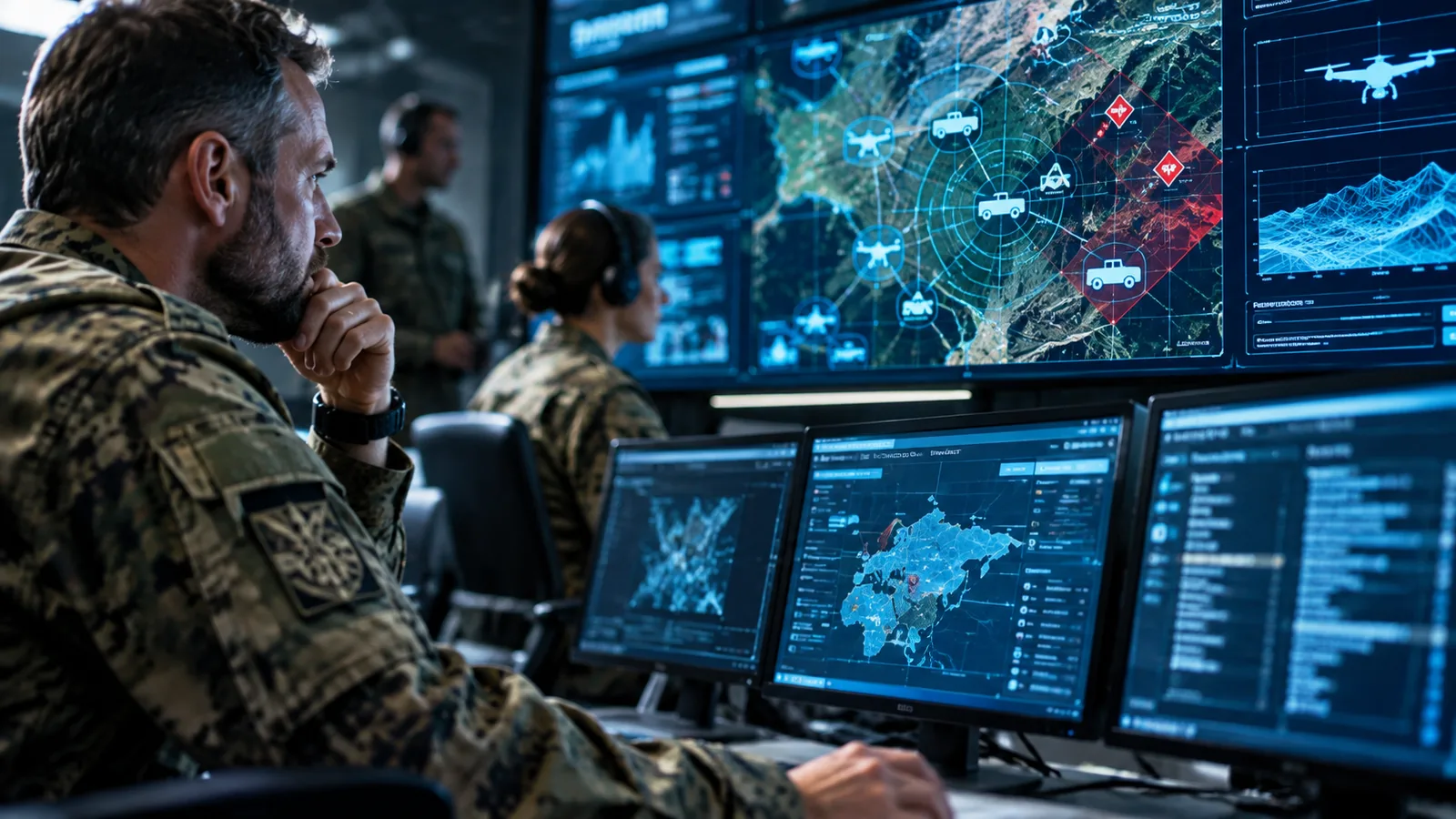
At an institutional level, strategic choices can involve investment in training, maintenance capability, digital resilience and infrastructure renewal. These compete for finite budgets, expertise and time. AI-assisted analysis could reveal dependencies or compare stated assumptions across proposals without determining institutional priorities itself.
A calculation may favour one option while overlooking a legal obligation, social consequence or political commitment. Some values cannot be represented faithfully in a common numerical objective. Decision-makers need both quantitative analysis and reasoned judgement, with a record of why an option was accepted or rejected.
Civilian logistics shows practical experience—not military proof
DTN's owner reports a colleague's AI logistics system in production across Europe, optimising thousands of daily movements of cars and industrial machinery. The reported system orchestrates AI agents, learns from completed movements and adapts within seconds to disruptions such as tyre punctures, driver sickness and schedule changes.
This account has not been independently verified by DTN. It establishes no military deployment, quantitative savings or demonstrated strategic judgement. The relevant lesson is narrower: continuously changing civilian logistics can motivate architectures that combine orchestration, replanning and feedback. Computing a revision within seconds is not the same as completing a physical response within seconds.
The AI military logistics article sets out the reported case and its boundaries. Civilian experience can inform feasibility questions; defence security, reliability and governance need separate evidence.
Hallucinations, deception and unknown unknowns remain real limits
Generative AI can produce fluent explanations containing unsupported statements. An answer with citations can still misinterpret its sources. Historical data may encode bias, and the situations represented in training may differ from those facing the institution. Confidence of expression should never substitute for verified evidence.
Adversarial or misleading data can contaminate analysis. Cybersecurity must therefore cover information intake, credentials, software dependencies and the integrity of model updates. Restricting access is necessary but insufficient: authorised information can still be wrong, stale or deliberately deceptive.
Unknown unknowns are not solved by a larger dashboard. Political objectives evolve; people respond nonlinearly; an intervention can change the context on which a prediction depended. AI does not inevitably outperform all humans, and analytical scale does not remove uncertainty. Overconfidence can turn a support tool into an institutional liability.
Explainability must support scrutiny, not merely sound convincing
Military AI decision support needs inspectable evidence, stated assumptions and a traceable record of model versions and revisions. An explanation should help reviewers reproduce or challenge the basis of an assessment. A generated narrative about why a model answered is not necessarily a faithful account of its reasoning.
The official NIST AI Risk Management Framework is intended for voluntary use and incorporates trustworthiness considerations into AI design, development, use and evaluation. It provides governance context, not certification of a proposed defence system. Sector-specific legal and security obligations still require qualified assessment.
Accountability must name real responsibilities: who approves inputs, who accepts a model change and who reviews a disputed output? Human oversight becomes ceremonial if reviewers lack time, evidence or authority to reject conclusions. Auditability should preserve disagreement as well as final approval.
Feedback loops must not quietly rewrite institutional priorities
Feedback can reveal recurring errors and improve bounded estimates. But an observed outcome is not automatically a valid learning target: the organisation may have acted on incomplete information, and the result may reflect external conditions. Learning from that record without review can reinforce a mistaken assumption.
Controlled evaluation, versioned changes and rollback are therefore central. Models may improve analytical components without being allowed to redefine political objectives or acceptable risk. The institution should monitor not only technical accuracy, but whether reliance on the tool narrows debate or discourages independent judgement.
Private and off-grid AI: software first, infrastructure second
Selected analytical services may run on private or edge infrastructure close to permitted data sources. Local processing can support continuity through some connectivity interruptions, but disconnected information becomes stale. Computing, storage, power and cooling remain finite, and controlled updates still need a secure process.
A rugged container is an optional deployment form, not the innovation. The core is governed software that integrates information and supports human analysis. Private does not mean inherently secure; off-grid does not mean indefinitely self-sufficient. DTN's air-gapped AI article distinguishes genuinely isolated systems from simply local or private deployment.
Discuss AI Decision Support with Defence Technology Specialists
DTN brings together people with experience in civilian AI orchestration and logistics. A useful conversation starts with a bounded analytical problem, approved data and explicit failure criteria. A pilot should test source traceability, uncertainty handling and whether people can challenge outputs—not advertise a military strategist before evidence exists.
Contact Defence Technology Network to discuss technical experts and pilot feasibility evaluation. DTN does not claim a deployed military strategist or military-ready system. The opportunity is to build better analytical support while keeping legitimacy, command and responsibility where they belong: with people.
Frequently asked questions
What does AI military strategy mean in this article?
It means AI-supported analysis of strategic questions about objectives, context, uncertainty, institutional resources and long-term choices. It does not mean targeting, tactical advice, combat optimisation or autonomous command. The headline is a thought-leadership proposition, not a claim that an accountable military strategist has been deployed.
Could AI replace human military strategists?
AI may assist information synthesis and structured analysis, but people retain responsibility for values, political legitimacy, legal obligations and command decisions. Analytical speed does not establish judgement or accountability. This article argues for an analytical co-strategist, not replacement of human command.
How does AI-agent orchestration support strategic analysis?
It coordinates specialist services within a controlled workflow, preserving their sources, assumptions and disagreements. It can integrate distinct information streams without pretending that every output is equally reliable. Validation, permission boundaries and human review are necessary; orchestration is not autonomous decision authority.
Does the reported civilian logistics case prove military capability?
No. The DTN owner-reported case concerns a European production system handling cars and industrial machinery. Its reported scale, learning and within-seconds adaptation have not been independently verified by DTN. Civilian experience can inform questions and feasibility work, not establish military readiness.
Can private AI decision support work without public cloud connectivity?
Selected services may operate locally if their dependencies, computing and data requirements fit the deployment. Disconnection limits access to current external information and does not remove security, maintenance or governance responsibilities. A rugged container is optional infrastructure, not the AI capability itself.
Sources and further reading
DTN technology conversations
Discuss AI Decision Support with Defence Technology Specialists
Connect with people experienced in civilian AI orchestration and logistics. Explore a bounded pilot and its evidence requirements—not a deployed military strategist or a military-ready system.
Related insights
AI & Data
AI Military Logistics: Why Self-Learning AI Is Changing Defence Logistics
Continuous adaptation, controlled learning and AI-agent orchestration: what a reported European civilian logistics case could mean for defence decision support.
C4ISR
AI Orchestration in Battle Management Systems: The Next Evolution of Command and Control
How connected AI services, sensor fusion and interoperable software architectures could transform military decision support.
C4ISR
Common Operating Picture (COP): How AI Supports Situational Awareness
What a common operational picture is, why data quality, provenance and latency decide its value, and where AI helps under human review.